The key issue affecting the racing product is the sheer amount of the product. On any given Saturday in North America there are upwards of two dozens tracks operating with a race commencing every minute. With this much product racing ceases to be an event and resembles an infomercial for a kitchen appliance on a never ending loop in a deserted big box store that nobody goes to in some anonymous blanched suburb. Go to any simulcast center or OTB and every race looks the same. In silence it is anonymous claimers running around in a circle, while older working class men yell and slap their behinds with the racing form. Instead of a complex blood and guts puzzle to contemplate the game is reduced to keno with domesticated animals.
Racing does not need to reinvent the wheel to bring back the big-event nature of the game. The white hot and trendy UFC only holds fights every few weeks. Thus every fight is hotly anticipated as a lack of supply stokes demand. Anticipation is marginalized when in a three minute span the 5th race from Finger Lakes is shortly followed by the 5th from Delaware which is followed by the 4th from Ellis.
This is where government intervention has damaged the collective racing product. The permission to subsidize purses with slot machine revenue has created entirely too much product. Racing has ceased to be a hobby of the wealthy and has become welfare for horsemen. While everyone deserves to be paid for their hard work they should not be subsidized when their work no longer has a market. Should neighborhood shoe repair stores be brought back from the service industry graveyard and be subsidized by slots too? Most of these racino subsidized tracks have an unappealing product and a purse structure that could never exist if not for the slot machine subsidy. Their presence is hurting the existence of neighboring tracks that operate on parimutuel waging alone pressuring them to acquire a slot machine subsidy as well.
The sheer amount of racing not only reduces the appeal of the racino product but it also dilutes the appeal of tracks in neighboring jurisdictions siphoning stables and decimating competition thus neutralizing the appeal of the product. The expansion of gambling from parimutuel wagering and Las Vegas to slots machines in every region is another example of the enlightenment establishment not considering the unintended consequences of their meddling. The horse racing industry has not benefited from the increased gambling even when it enriches the purse structure temporarily it sets in motion the process that will eventually ruin the collective industry by market saturation and the loss of the fickle public as racing fans.
In the past I have advocated a laissez faire approach to the current challenges of the horse racing industry. Call it an intellectual breakthrough but I now believe that the laissez faire approach is the road to ruin for racing. There are too many jurisdictions with too many local interests that have the game "drifting like a rudderless ship". At this point centralized influence and power would greatly help in providing "friendly persuasion" to the market forces affecting racing. The ship can not continue to drift and take on more product while the bulkhead of the ship takes on more water.
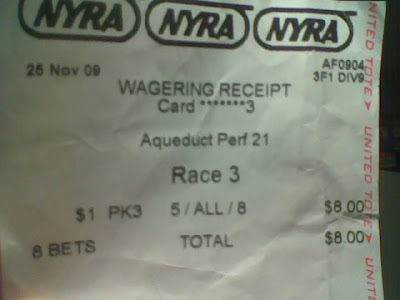
Power cap- existential handicapping
Showing posts with label racing commissioner. Show all posts
Showing posts with label racing commissioner. Show all posts
04 September 2009


25 June 2009
Dear Abigail, (The Category Killer Track)
Commenter Abigail made an excellent point in the Rachel Alexandra marketing post regarding how most people show up for triple crown racing for the party and not the horses. This crowd could really care less about the horses. They are there to hang out, get drunk and have a good time. Their good time y does not include watching or betting on horse racing. Any bets made are just ancillary entertainment. These people will not come back until next year when the TV starts talking about the triple crown all over again.
Marketing a special filly mostly falls on deaf ears. Most people are just not sharp enough to appreciate equine excellence or acknowledge it when they see it. These days when it comes to horses people don't know a throat latch from a trifecta box. The thing that people respond to is controversy and large groups of people all doing the same thing. People move in herds like Bison, cherishing the safety of the group. The challenge before racing is to create a real buzz, to create a watering hole to lure the herd. Racing needs to create excitement to drown out the mundane gossip about ballgames and ballplayers on sports AM radio. Racing needs get the masses talking about their single in Saturday's pick 4 instead of who is A-Rod dating now that he is single.
The only marketing that will get the job done is an idea posted by a commenter named "Cholly" in a previous post. The idea was about a "category killer" track that had 100K allowance races, 10% takeout with huge wagering pools and huge fields. Add in a revolutionary tote system based on Betfair that allows players to lay horses and racing could generate the necessary buzz to lure the herd of masses away from the malls and ballpark clip joints. This would be racing at its best and wagering on a grand scale. These would be mutuel pools that dominate the industry, perhaps even putting smaller tracks out of business and concentrating the public's fascination on the mega-meet.
Once the ball starts rolling with the masses their attention tends to accumulate on one subject making that entity a runaway success. Racing is just hanging on with a small but loyal niche audience. There is untapped potential for racing to be a top pleasure activity. When the gambling action filled with intrigue, the racing so interesting, masses of people would gravitate towards it. For this to happen the idea would have to be something completely new and completely out of the box. The marketing idea would have to be fraught with risk, something to surprise people and change the way people think about racing. The "category killer" track looms as something to bring racing back into the mainstream.
Marketing a special filly mostly falls on deaf ears. Most people are just not sharp enough to appreciate equine excellence or acknowledge it when they see it. These days when it comes to horses people don't know a throat latch from a trifecta box. The thing that people respond to is controversy and large groups of people all doing the same thing. People move in herds like Bison, cherishing the safety of the group. The challenge before racing is to create a real buzz, to create a watering hole to lure the herd. Racing needs to create excitement to drown out the mundane gossip about ballgames and ballplayers on sports AM radio. Racing needs get the masses talking about their single in Saturday's pick 4 instead of who is A-Rod dating now that he is single.
The only marketing that will get the job done is an idea posted by a commenter named "Cholly" in a previous post. The idea was about a "category killer" track that had 100K allowance races, 10% takeout with huge wagering pools and huge fields. Add in a revolutionary tote system based on Betfair that allows players to lay horses and racing could generate the necessary buzz to lure the herd of masses away from the malls and ballpark clip joints. This would be racing at its best and wagering on a grand scale. These would be mutuel pools that dominate the industry, perhaps even putting smaller tracks out of business and concentrating the public's fascination on the mega-meet.
Once the ball starts rolling with the masses their attention tends to accumulate on one subject making that entity a runaway success. Racing is just hanging on with a small but loyal niche audience. There is untapped potential for racing to be a top pleasure activity. When the gambling action filled with intrigue, the racing so interesting, masses of people would gravitate towards it. For this to happen the idea would have to be something completely new and completely out of the box. The marketing idea would have to be fraught with risk, something to surprise people and change the way people think about racing. The "category killer" track looms as something to bring racing back into the mainstream.
03 June 2009
Racing Gaining Appeal As Breeding Game Loses Its Allure
Frank from California brings up an excellent point in his comments under the Commish post from earlier this week.
This is not a micro-control issue, it is a macro-economic self interest issue. There is no commissioner or league office that could dictate terms to an owner. What kind of society would allow a commissioner or tyrannical government to force owners to act against their own self interest for the collective good of the game? Hopefully not the United States. While the major ball sport leagues are dealing with a few dozen owners racing is made up of thousands if not tens of thousands of owners. These owners have a right to their self interest and are free to do what is best for their personal self interest. It is a testament to the game that it has survived two decades of owners self interest being in direct opposition to what is in the games collective best interest. Colt after colt retired early, robbing the game of stars and story lines. You may not realize it yet but the era of the breeding tail wagging the racing tail is over.
Now that the economic bubble has burst and the dollar is actively being debased the breeding game has lost much of its economic appeal. Marginal stakes winners that could have had a successful niche at stud will no longer find success. Stud fees are dropping and foal totals are down. A change that would taken a racing commissioner decades to accomplish has now quickly become reality on the winds of changing times. It is time for racing to carpe diem. A strengthened position will yield dividends.
Everyone should be bullish on the racing game as it is now more attractive to keep that top colt racing through the four year old season than in any other time in the last twenty years. Stakes racing on TV is trouncing ball sport playoff games. The market for stud horses is saturated and is in retreat. Racing is one brilliant colt or filly away from capturing the imagination of the masses. If that colt, filly or gelding remains in training for more than one season we could find the game on the S.I. cover frequently and discussed at the water cooler. Ball sports have peaked. There is a growing backlash against high ticket prices. Racing is an attractive economic option is these times. With relatively inexpensive admission cost and potential for gambling fun racing can look forward to growth in the next few years while ball sports and their tired formulas fail. A perfect storm of favorable economic conditions combined with a little bit of luck is all racing needs to cycle back to the mainstream.
The whole problem revolves around the good horses being retired to soon. In other sports you have the same headliners year after year. Fans can't wait to see the favorite in action,Frank is unquestionably on the money when he says that fast tracking stakes to the breeding shed have diminished the appeal of horse racing. Smarty Jones was an absolute powerhouse for the game but his time was too short to make a lasting impact. Where some people divert from reality is blaming selfish owners or thinking that some mighty commissioner type could do something about this. A commissioner would be impotent in the realm of dictating horse retirement in an economic climate of a highly lucrative breeding game.
Racing, it has to re-invent itself every yesr. You remember John Henry, had a big following, was a household name. Why, how long did he race, and win. You seen the following Curlin was attracting -- then gone!
The high powers of racing are to stupid to realize, or, understand what the fan wants. Their only thought is money in their own pocket. There has been blame put in every area but the right one. Synthetic tracks, medications, standardization, they all miss the mark. Actually they have been created to take the focus off the real problem, early retirement. The people at the top are the one's killing racing through their own greed, and stupidity. You start out with a wrong premise -- synthetic tracks, medications, standardization --- you wind up with wrong answers and conclusions.
Frank Lancelotti
California
This is not a micro-control issue, it is a macro-economic self interest issue. There is no commissioner or league office that could dictate terms to an owner. What kind of society would allow a commissioner or tyrannical government to force owners to act against their own self interest for the collective good of the game? Hopefully not the United States. While the major ball sport leagues are dealing with a few dozen owners racing is made up of thousands if not tens of thousands of owners. These owners have a right to their self interest and are free to do what is best for their personal self interest. It is a testament to the game that it has survived two decades of owners self interest being in direct opposition to what is in the games collective best interest. Colt after colt retired early, robbing the game of stars and story lines. You may not realize it yet but the era of the breeding tail wagging the racing tail is over.
Now that the economic bubble has burst and the dollar is actively being debased the breeding game has lost much of its economic appeal. Marginal stakes winners that could have had a successful niche at stud will no longer find success. Stud fees are dropping and foal totals are down. A change that would taken a racing commissioner decades to accomplish has now quickly become reality on the winds of changing times. It is time for racing to carpe diem. A strengthened position will yield dividends.
Everyone should be bullish on the racing game as it is now more attractive to keep that top colt racing through the four year old season than in any other time in the last twenty years. Stakes racing on TV is trouncing ball sport playoff games. The market for stud horses is saturated and is in retreat. Racing is one brilliant colt or filly away from capturing the imagination of the masses. If that colt, filly or gelding remains in training for more than one season we could find the game on the S.I. cover frequently and discussed at the water cooler. Ball sports have peaked. There is a growing backlash against high ticket prices. Racing is an attractive economic option is these times. With relatively inexpensive admission cost and potential for gambling fun racing can look forward to growth in the next few years while ball sports and their tired formulas fail. A perfect storm of favorable economic conditions combined with a little bit of luck is all racing needs to cycle back to the mainstream.
01 June 2009
Racing Does Not Need A Commissioner
Racing's greatest strength is that it does not have a national commissioner. Every other sports league has the same format, uses the same market research and same approach to lure the same groups of masses to buy their t-shirts and plunk down a few hundred to sit and watch an AV show at one of its games. Racing is the only diverse kid on the block, it is a different type of game, with a distinctive yet authentic appeal. Racing should not try to emulate sports leagues like the NFL or NBA or MLB. These sports leagued peaked in the 1990's and have began their decline. Kids are no longer interested in Baseball much anymore, and as a game it will greatly reduce in popularity over the next generation. Instead of copying a tired formula racing should do what it has always done, but do it better. Let the market forces at work downsize the number of tracks in operation, there is too much racing and most of it is forgettable. Right size, form new racing circuits and accentuate the positives of a great game. Racing's authentic appeal has stood the test of time, we could be one or two years away from a tremendous renaissance, spurred by a return to all things authentic and racing's internet advantage.
This diversification of ideas and management styles keeps the game fresh and surprisingly strong when the death of racing was long ago expected. A national commissioner of racing would have the game controlled by some over educated, under experienced bore, who would employ well worn marketing techniques to all tracks. Racing would expose itself to the same affliction that the banking industry is suffering. Too much consolidation and too many banks all doing the same exact thing, using the same risk models killed banking. Banking was better off when there were hundreds of banks all doing different things. The competition is working for tracks like Keeneland, NYRA and Tampa. These tracks have improved their product in recent years and surged forward past tracks that are stuck in a rut. Without diversity of management news ideas are stifled under the weight of me-too think.
Racing is a real game and not a master planned, referee controlled, TV commercial vehicle. Racing is different and different is a good survival technique. In real estate terms racing is like an aging urban neighborhood. Horse racing is old, filled with history, with well built brownstones that have stood the test of time. The masses stay away do the rough conditions and the bitter degenerates found on the corners there. However one persons slum is another persons opportunity. A cosmopolitan capitol like Rome could become a backwater is a few generations and an aging urban neighborhood has potential to become the next hot area. Life works in cycles. Racing has the potential to expand as it has a steady and permanent revenue source in wagering and racing is just north of Excitinsvillle.
Sports like the NFL or NBA are master planned neighborhoods in a Sunbelt Cul-De-Sac borefest. People are leaving these suburban master planned communities in droves. Like a master planned community the action in TV balls sports are contrived, phony and shallow. Master planned areas are so 1980's. Racing has the authentic appeal to attract people when they are sick of the phony action, when the horns prompting them to cheer no longer work and when they become tired of sportscasters telling them what to think. When the days of the master planned community in the suburbs fell out of vogue a former working class area like Williamsburg Brooklyn was there to take advantage of the stream of young hipsters looking for an authentic experience. Racing could be there too when sports fans tire of the phony master planned sports experience.
Where I am from in Brooklyn was a working class European neighborhood in 1960 then after some government intervention coupled with cheap suburban housing the working class neighborhood was suddenly a burnt out wasteland in 1977. After about 20 years of drugging, whoring, and robbing this former wasteland is now a hot area attracting trust-fund hipsters to experience the authentic energy of an old-school urban environment. Bushwick is a clear example of a turnaround, racing has the potential to have a similar turnaround.
Racing has the same authentic appeal of an older neighborhood in any of the great Northern hemisphere cities. Times are always changing and life works in cycles. If a wasteland can become the next hot neighborhood, racing can be the next hot sport. Racing's time is coming around again, and the worst thing it could do is to try and re-model the game around a master planned community that is suddenly going out of style, complete with a commissioner, mandatory races and trumped up inauthentic excitement. Racing needs to keep its authentic appeal and trim some of its weaker content. Racing has, is and will continue to take advantage of the internet. The internet is great for racing. The investment that Twinspires has made in the twinspires.com website has been impressive. Between internet wagering, internet past performances and internet replays, following the horses has become a seamless experience with tremendous amounts of information at your fingertips. Racing works better on the internet than any other sport.
What racing has to do is right size. The prime issue in American racing is quantity. There is too much racing. The preponderance of slot machine racetracks is weakening the game. Horses are racing but nobody cares and few people are betting on these races. These mundane, slot machine revenue distribution vehicles are pulling horses away from racetracks that support real racing. Real racing is a card full of horses that people want to watch and want to bet on. Real racing is an event, not a slot machine revenue distribution vehicle. These slots fueled races are like model homes that sit idle, subsidized by slot machines they pull residents from the vital area of town. If this continues soon racing will look like Detroit. If the slot tracks survive and cherished facilities like Pimlico or Hollywood have to close we will have to deal with it. The market forces will handle right sizing the game better than a commissioner could ever dream of. It is better to have a healthy game than a game on life support filled with disease ridden tracks.
Racing in the mid-Atlantic needs to organize, a circuit should be formed from Delaware south to Virginia. Perhaps Twin Spires owned Arlington, Fairgrounds and Churchill could work their way into becoming a circuit. Perhaps the three slot tracks in Pennsylvania could become a circuit as well. Finley expands on many of these points. They are building yet another track in New Mexico to take advantage of slot revenues, this is terrible news as it should mark the end of Texas tracks like Lone Star and Sam Houston. Who thought that when Presque Isle opened a few years ago that it would diminish Churchill?
The diversity of management styles of the different tracks and governmental agencies running racing ensures competition between tracks and a steady flow of new ideas. Racing is just a lucky horse away from catching fire once again. Unfortunately like in Brooklyn in the 1970's government intervention is stifling the renaissance but we can be sure that racing will have its time in the limelight soon enough.
This diversification of ideas and management styles keeps the game fresh and surprisingly strong when the death of racing was long ago expected. A national commissioner of racing would have the game controlled by some over educated, under experienced bore, who would employ well worn marketing techniques to all tracks. Racing would expose itself to the same affliction that the banking industry is suffering. Too much consolidation and too many banks all doing the same exact thing, using the same risk models killed banking. Banking was better off when there were hundreds of banks all doing different things. The competition is working for tracks like Keeneland, NYRA and Tampa. These tracks have improved their product in recent years and surged forward past tracks that are stuck in a rut. Without diversity of management news ideas are stifled under the weight of me-too think.
Racing is a real game and not a master planned, referee controlled, TV commercial vehicle. Racing is different and different is a good survival technique. In real estate terms racing is like an aging urban neighborhood. Horse racing is old, filled with history, with well built brownstones that have stood the test of time. The masses stay away do the rough conditions and the bitter degenerates found on the corners there. However one persons slum is another persons opportunity. A cosmopolitan capitol like Rome could become a backwater is a few generations and an aging urban neighborhood has potential to become the next hot area. Life works in cycles. Racing has the potential to expand as it has a steady and permanent revenue source in wagering and racing is just north of Excitinsvillle.
Sports like the NFL or NBA are master planned neighborhoods in a Sunbelt Cul-De-Sac borefest. People are leaving these suburban master planned communities in droves. Like a master planned community the action in TV balls sports are contrived, phony and shallow. Master planned areas are so 1980's. Racing has the authentic appeal to attract people when they are sick of the phony action, when the horns prompting them to cheer no longer work and when they become tired of sportscasters telling them what to think. When the days of the master planned community in the suburbs fell out of vogue a former working class area like Williamsburg Brooklyn was there to take advantage of the stream of young hipsters looking for an authentic experience. Racing could be there too when sports fans tire of the phony master planned sports experience.
Where I am from in Brooklyn was a working class European neighborhood in 1960 then after some government intervention coupled with cheap suburban housing the working class neighborhood was suddenly a burnt out wasteland in 1977. After about 20 years of drugging, whoring, and robbing this former wasteland is now a hot area attracting trust-fund hipsters to experience the authentic energy of an old-school urban environment. Bushwick is a clear example of a turnaround, racing has the potential to have a similar turnaround.
Racing has the same authentic appeal of an older neighborhood in any of the great Northern hemisphere cities. Times are always changing and life works in cycles. If a wasteland can become the next hot neighborhood, racing can be the next hot sport. Racing's time is coming around again, and the worst thing it could do is to try and re-model the game around a master planned community that is suddenly going out of style, complete with a commissioner, mandatory races and trumped up inauthentic excitement. Racing needs to keep its authentic appeal and trim some of its weaker content. Racing has, is and will continue to take advantage of the internet. The internet is great for racing. The investment that Twinspires has made in the twinspires.com website has been impressive. Between internet wagering, internet past performances and internet replays, following the horses has become a seamless experience with tremendous amounts of information at your fingertips. Racing works better on the internet than any other sport.
What racing has to do is right size. The prime issue in American racing is quantity. There is too much racing. The preponderance of slot machine racetracks is weakening the game. Horses are racing but nobody cares and few people are betting on these races. These mundane, slot machine revenue distribution vehicles are pulling horses away from racetracks that support real racing. Real racing is a card full of horses that people want to watch and want to bet on. Real racing is an event, not a slot machine revenue distribution vehicle. These slots fueled races are like model homes that sit idle, subsidized by slot machines they pull residents from the vital area of town. If this continues soon racing will look like Detroit. If the slot tracks survive and cherished facilities like Pimlico or Hollywood have to close we will have to deal with it. The market forces will handle right sizing the game better than a commissioner could ever dream of. It is better to have a healthy game than a game on life support filled with disease ridden tracks.
Racing in the mid-Atlantic needs to organize, a circuit should be formed from Delaware south to Virginia. Perhaps Twin Spires owned Arlington, Fairgrounds and Churchill could work their way into becoming a circuit. Perhaps the three slot tracks in Pennsylvania could become a circuit as well. Finley expands on many of these points. They are building yet another track in New Mexico to take advantage of slot revenues, this is terrible news as it should mark the end of Texas tracks like Lone Star and Sam Houston. Who thought that when Presque Isle opened a few years ago that it would diminish Churchill?
The diversity of management styles of the different tracks and governmental agencies running racing ensures competition between tracks and a steady flow of new ideas. Racing is just a lucky horse away from catching fire once again. Unfortunately like in Brooklyn in the 1970's government intervention is stifling the renaissance but we can be sure that racing will have its time in the limelight soon enough.
Subscribe to:
Posts (Atom)


